

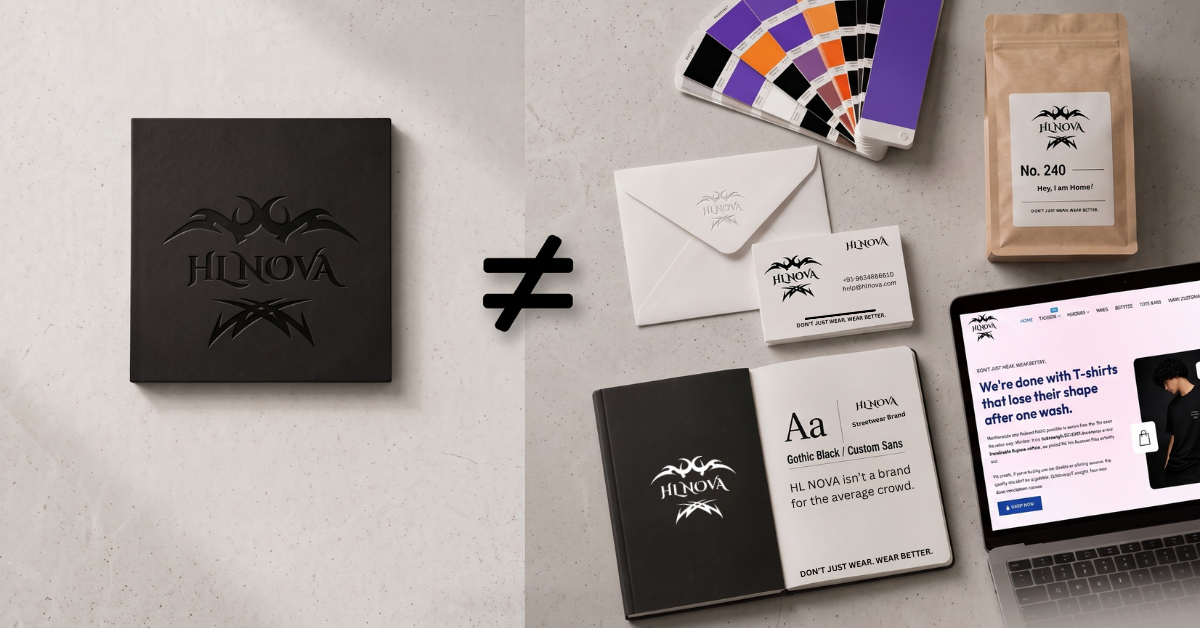
The fundamental difference between a logo and a brand centers on visual identification versus market perception. A logo is an isolated graphic mark that enables customers to recognize an enterprise. In contrast, a brand is the cumulative emotional, operational, and psychological sentiment that buyers hold toward that organization. Confusing these two distinct assets leads founders to invest capital in cosmetic redesigns while ignoring broken client communication, fragmented value propositions, or inferior service delivery. A vector graphic alone cannot repair an operational disconnect.
What Is the Fundamental Distinction Between a Logo and a Brand
The core difference between a brand and a logo is that a logo delivers visual recognition, while a brand creates commercial trust and customer loyalty. A logo is a tangible design asset consisting of shapes, typography, and colors. A brand is an intangible market perception built from customer service, product quality, company culture, and public reputation.
To understand how these two assets function together in the market, businesses must look at their operational roles across five core dimensions.
- Primary Commercial ObjectivesA logo delivers instant visual differentiation in crowded physical and digital marketplaces. A brand builds long-term customer retention, organic brand advocacy, and sustained pricing power.
- Asset Nature and TangibilityA logo exists as a tangible graphic file, typography set, and defined color palette. A brand exists as an intangible collection of customer sentiment, expectations, and operational trust.
- Creation and Cultivation TimelinesA visual mark is designed within days or weeks by professional graphic artists. A legitimate brand is cultivated over months or years of consistent product quality and reliable execution.
- Direct Impact on BuyersA logo tells buyers who you are visually at first glance. A brand gives buyers a compelling reason to choose, recommend, and return to your business.
- Functional LimitsA logo cannot fix poor service, deceptive pricing, or low product quality. A brand directly dictates whether an enterprise survives ruthless market competition over the long haul.
How Does a Logo Contribute to Overall Brand Identity
A logo contributes to brand identity by serving as the primary visual anchor for an enterprise. It functions as the entry point for customer memory, allowing buyers to link past experiences, positive emotions, and product reliability to a single graphic symbol.
Graphic identifiers generally take five standard structural forms across modern commerce.
Wordmarks present an enterprise name using custom typography, as seen with Google, Sony, and Visa. Brand marks or symbols rely on abstract or pictorial icons without text, such as the Apple silhouette, the Nike swoosh, or the Shell emblem. Monograms and lettermarks condense lengthy corporate names into clean visual initials like IBM or Louis Vuitton. Combination marks lock together a graphic symbol with a stylized company name, providing both pictorial and typographic identification. Finally, emblems enclose corporate typography and iconographic details inside an integrated badge or seal, as seen with Starbucks and Porsche.
When buyers see the crocodile brand logo on a polo shirt, they instantly connect the image to Lacoste. This visual recall highlights the difference between a brand logo and a brand symbol in daily commerce.
Nevertheless, a visual identifier has rigid operational limits. A logo cannot validate product durability, explain corporate values, train customer support representatives, or ensure on-time order fulfillment. It stands merely as the visual marker at the conclusion of a commercial transaction.
Comparing Brands, Logos, Slogans, and Trademarks
Brands, logos, slogans, and trademarks differ by their functional roles in commercial communication and legal protection. A brand represents market reputation, a logo provides visual identity, a slogan articulates the core marketing promise, and a trademark legally protects those proprietary assets from unauthorized commercial infringement.
Businesses frequently confuse branding terminology, leading to misaligned project briefs and incomplete legal protection. Understanding the operational scope of each asset ensures clear communication when hiring creative teams and protecting intellectual property.
- The BrandA brand shapes overall market perception and builds consumer trust. Its operational scope covers intangible reputation, service delivery, and market positioning. For example, Nike represents athletic performance, relentless innovation, and personal motivation.
- The LogoA company logo delivers complete, unified visual identification. Its operational scope centers on the primary graphic file combining typographic names and symbols. Nike expresses this through their typographic name anchored to the iconic swoosh.
- The Brand MarkA brand mark delivers non-verbal recognition through a standalone symbol without accompanying typography. The standalone curved Nike swoosh is a textbook example of non-verbal graphic recall.
- The Slogan or TaglineA slogan summarizes the company value proposition in a brief, memorable verbal statement. Nike uses “Just Do It” as an enduring verbal marketing anchor across media campaigns.
- The Registered TrademarkA trademark secures commercial assets from unauthorized imitation. Its operational scope covers statutory legal protection over the mark, name, and phrase, giving the business exclusive rights to use those identifiers in trade.
This distinction highlights the practical reality of trademarks versus logos versus brands. A company logo provides visual presence. A trademark delivers statutory defense. A brand provides the commercial justification for prospective clients to buy.
What Is the Difference Between Logo Design and Brand Design
The difference between logo design and brand design is that logo design focuses on graphic aesthetics, while brand design creates an entire commercial positioning framework. Logo designers work on graphic balance, kerning, color contrast, and file scalability. Brand strategists and brand designers conduct market research, define buyer personas, set verbal tone of voice, and align customer touchpoints.
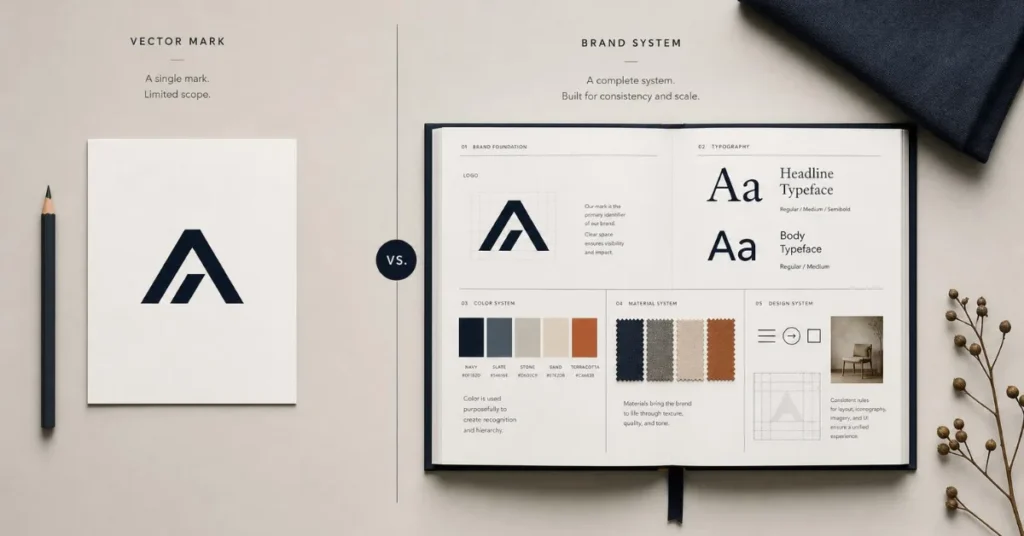
Logo design focuses on the visual mark, while complete brand design establishes the wider design system and operational standards.
While both disciplines share common creative software, their core deliverables and execution timelines target fundamentally different business goals.
- Core Deliverables and AssetsLogo design produces vector files, export formats, basic color codes, and typographic pairings. Comprehensive brand design delivers brand guidelines, customer personas, value proposition frameworks, voice rules, and scalable design systems.
- Development Timelines and Specialist RolesA standalone graphic mark typically takes one to three weeks of creative production handled by a graphic designer or vector illustrator. Strategic brand development requires four to eight weeks of market research and operational mapping driven by brand strategists, creative directors, and marketing researchers.
These distinct workflows directly shape how a business performs in its category. A polished logo creates immediate visual distinction on screens, storefronts, and physical packaging. However, a complete brand design system is what builds customer lifetime value, market authority, and sustainable pricing power over years of operation.
Can a Strong Brand Exist With a Simple or Minimal Logo
A strong brand can succeed with a minimal logo because customer trust comes from product quality, reliable service, and everyday user experience. Many major enterprises scale to multi-million dollar revenues using basic typographic wordmarks without decorative symbols.
Here is a practical operational example using two retail startups. Both companies sell custom graphic apparel made from identical 240 GSM bio-washed cotton, and both launch modern web storefronts.
The first company fulfills orders within seventy-two hours, publishes clear sizing guidelines, honors exchange guarantees without friction, and maintains proactive support. The second competitor delivers weeks late, ignores support tickets, and hides contact information.
Although both graphic logos display equal artistic quality, the market views these two enterprises in entirely different tiers. The first builds brand equity, customer loyalty, and sustainable pricing power. The second produces negative sentiment and constant dispute claims. That operational contrast shows the true difference between a logo and overall brand reputation.
How Brand Identity Influences SEO, AEO, and GEO Entity Recognition
Brand identity directly influences search visibility because search engines and artificial intelligence answer engines review businesses as verified knowledge graph entities rather than isolated keyword targets. In Answer Engine Optimization and Generative Engine Optimization, algorithms look for consistent digital citations, verified public profiles, and positive sentiment to confirm entity authority.
Consistent brand naming and digital citations build verified Knowledge Graph entities that rank across organic search and AI Overviews.
Publishing variations of a brand name, irregular trade descriptions, or conflicting regional addresses across your website, LinkedIn profile, and Google Business Profile splinters search engine knowledge graphs. In addition, if a website claims an enterprise is an apparel manufacturing facility, while external press coverage lists the firm as a digital dropshipping hub, generative answer engines face semantic conflict and drop the company from automated AI summaries.

Maintaining uniform brand descriptions, verified directory listings, and active digital public relations confirms to search engines that an organization is a genuine, active enterprise. This synchronized footprint directly improves organic rankings, positions pages to trigger Google AI Overviews, and increases brand citations within generative search engines.
How Much Does It Typically Cost to Develop a Logo Versus a Full Brand Identity
Developing a logo versus a full brand identity typically costs between ₹10,000 to ₹40,000 INR ($150 to $500 USD) for a standalone graphic mark, compared to ₹2,00,000 to ₹6,00,000+ INR ($4,000 to $15,000+ USD) for a complete strategic brand rollout. Pricing scales based on market research, positioning depth, and operational touchpoint mapping.
Investment levels generally fall into three practical commercial tiers depending on the maturity of the business.
- Basic Logo CreationThis entry tier covers vector source files, high-resolution PNG exports, primary color codes, and black and white file variants. Projects in this category range from ₹10,000 to ₹40,000 INR ($150 to $500 USD). This scope suits founders in early bootstrap phases, hobby projects, or quick proof-of-concept tests.
- Visual Identity SystemsThis intermediate tier delivers logo variants, icon systems, complete typographic hierarchy, stationery templates, and branded social media layouts. Pricing ranges from ₹50,000 to ₹1,50,000 INR ($1,000 to $3,500 USD). This package is designed for growing small businesses, active e-commerce storefronts, and professional service firms.
- Strategic Brand Identity DevelopmentThis enterprise tier includes deep market analysis, brand positioning architecture, verbal voice guidelines, a complete corporate brand book, and an operational launch roadmap. Pricing typically spans ₹2,00,000 to ₹6,00,000+ INR ($4,000 to $15,000+ USD). This level of investment is necessary for expanding regional enterprises, venture-funded startups, or established companies preparing for a total corporate repositioning.
Investing in complete brand development early prevents the compounding expenses of legal trademark re-filings, physical signage replacements, and web overhauls later in the business lifecycle.
How to Build a Strong Brand Beyond Designing a Logo
Building a strong brand beyond designing a logo requires aligning validated market research, strategic positioning, verbal messaging, and disciplined customer service benchmarks. While a visual mark attracts immediate visual attention, customer retention and pricing power depend on operational reliability across all real-world customer touchpoints.
Customer expectations shift across commercial sectors, whether in jewellery, manufacturing, construction, fashion, or cosmetics. Professional agencies like 11 Media Branding & Marketing Agency emphasize that while a sharp graphic mark catches initial attention, sustainable pricing power and customer retention rely on product reliability and service consistency across everyday operations.
Building an enduring brand requires following a disciplined five-stage operational framework that anchors visual design to validated commercial strategy.
- Phase 1: Customer and Market ResearchThe focus centers on uncovering customer pain points and evaluating direct competitors. Deliverables include customer persona matrices, competitor audit sheets, and identified market gaps.
- Phase 2: Strategic PositioningThis stage establishes competitive advantages and category authority. Deliverables include a clear value proposition, pricing structure, and formal brand differentiation statements.
- Phase 3: Verbal Identity StandardsTeams craft cohesive company messaging, tone of voice, and public marketing hooks. Deliverables include brand voice guidelines, core elevator pitches, marketing taglines, and standardized customer service scripts.
- Phase 4: Visual System DevelopmentDesigners translate validated commercial strategy into functional graphic assets. Deliverables include primary and secondary logos, flexible color systems, typography pairings, and layout templates.
- Phase 5: Touchpoint DeploymentThe company aligns all outward-facing channels to the new system. Deliverables include standardized product packaging, storefront signage, website user interfaces, and unified client contracts.
Why Do Some Companies Rebrand Without Changing Their Logo
Companies rebrand without changing their logo because their visual mark already commands strong market recognition, but their internal operations, target demographics, or product lines have shifted. Modifying a globally recognized symbol can destroy valuable brand equity, so organizations choose to overhaul messaging, customer experience, and service benchmarks while keeping the familiar graphic mark intact.
For any growing startup, knowing when to update visual assets versus company operations is critical to managing capital efficiently.
An enterprise requires a simple logo refresh when existing visual marks display poorly on mobile device screens or app icons, when typography appears visually outdated while sales figures remain healthy, or when the business needs flat vector variations for modern screen-printing, embroidery, or dark-mode interfaces.
A business requires a comprehensive strategic rebrand when the company pivots toward higher-value commercial tiers or expands into international territories, when corporate mergers require a single unified identity, when the existing brand suffers from negative public perception, or when inbound prospects consistently misunderstand the core services and products the company delivers.