

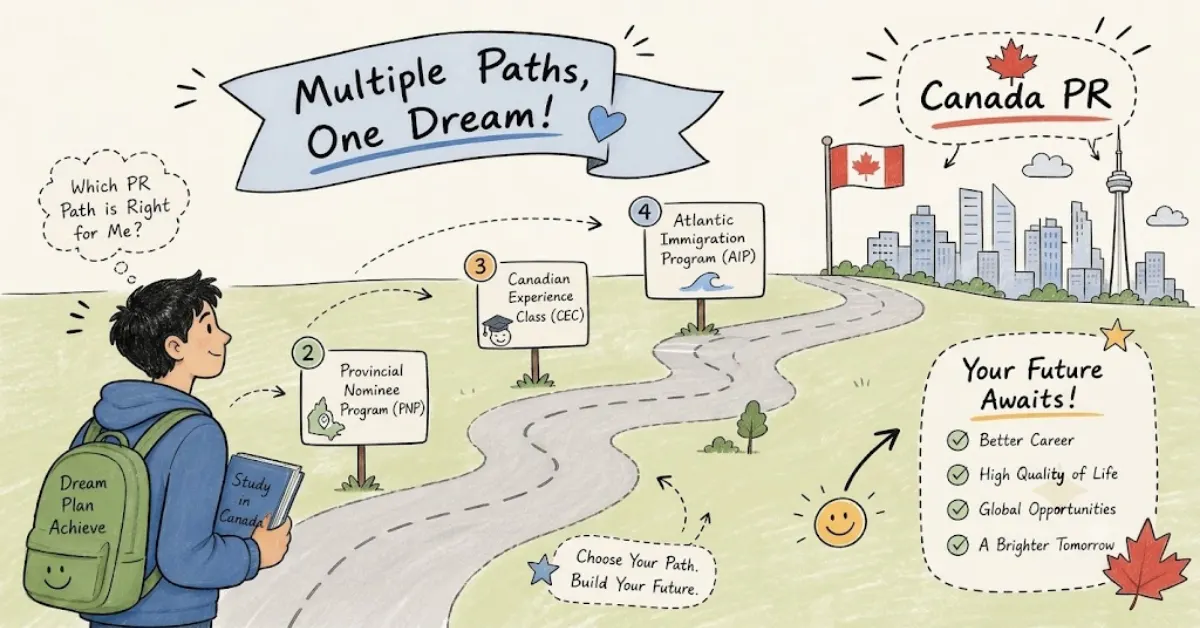
If you’re asking what are the best pathways to get Canada PR for Indian students, this guide gives you a direct, structured answer. Indian students represent one of the largest international student populations in Canada, consistently among the top two or three source countries by enrollment, according to IRCC data, but converting a Canadian degree into permanent residency takes more than graduating and hoping for the best. The pathways exist, they are proven, and the timelines are achievable. The catch is picking the right one for your credential and the province where you studied. This guide covers the top study-to-PR routes available to Indian students in 2026: the Post-Graduate Work Permit, Express Entry’s Canadian Experience Class, Provincial Nominee Programs, and the Quebec Experience Program.
Recent headlines claiming Canada halts PR pathways have triggered widespread confusion, but the actual policy shift is about precision, not total closure. Across student discussions on platforms like The Post Villa, Indian graduates consistently ask the same fundamental question: where do I actually begin? Navigating PR pathways in Canada for international students now demands a calculated strategy rather than generic advice. By the end of this guide, you will know exactly which route matches your credential and which three steps to take first.
What Are the Best Pathways to Get Canada PR for Indian Students: PGWP, CEC, PNP, and PEQ
Understanding how each route works, and how they connect, is the foundation of any solid PR strategy. The sections below break down each pathway in detail, starting with the bridge that makes most of them possible.
How the PGWP Sets Up Your Entire PR Strategy
The Post-Graduate Work Permit is not PR itself, but it is the single most important bridge between your Canadian education and permanent residency. Without a valid PGWP, most federal and provincial PR pathways become significantly harder to access for recent graduates, since the work experience required for programs like the Canadian Experience Class is typically earned on a PGWP. Planning for PGWP eligibility from the start of your studies is non-negotiable.
Which Programs and Credentials Qualify in 2026
Core PGWP eligibility requires graduating from a PGWP-eligible Designated Learning Institution, maintaining full-time status throughout your studies, and applying within 180 days of program completion. For non-degree programs, the field-of-study requirement that took effect November 1, 2024 adds an extra layer: your program’s CIP code must fall within IRCC’s eligible sectors, which include healthcare, STEM, agriculture, trades, transport, and education. Bachelor’s, master’s, and doctoral degrees are exempt from the field-of-study restriction, which is one major reason degree programs are safer bets than certificates or diplomas for PR planning purposes.
Programs that do not qualify at all include anything under 8 months, programs delivered under a curriculum licensing agreement (with limited exceptions), and non-degree programs outside the eligible field-of-study list. If you are evaluating a college diploma or certificate, confirm the specific CIP code with the institution before you enroll, not after.
How PGWP Duration Varies by Credential Type
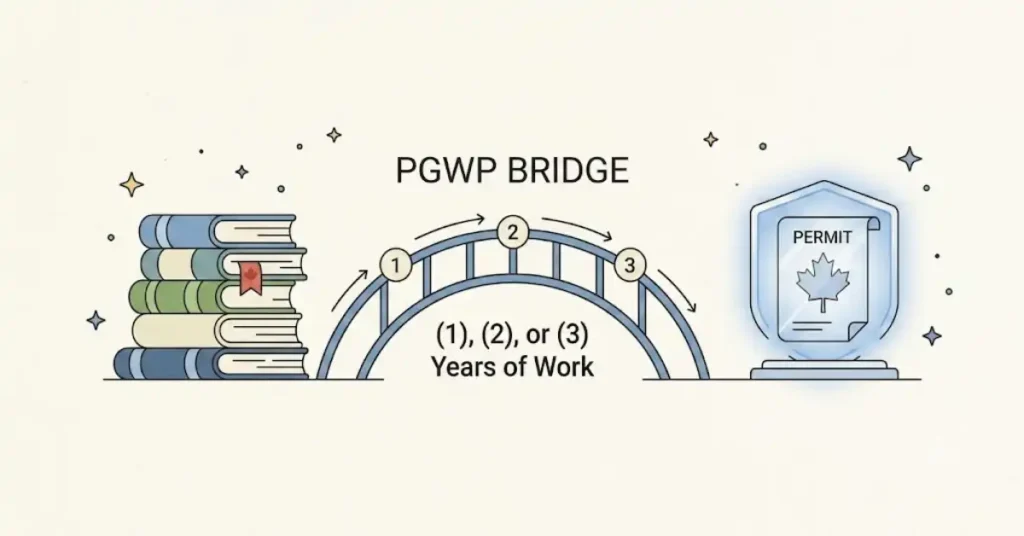
The permit length follows a straightforward rule for most applicants. Programs of two or more years lead to a PGWP of up to three years. Programs of 8 months to under two years receive a PGWP matching the program’s length. The standout exception applies to most master’s degree graduates: IRCC guidance allows a three-year PGWP even if the program was shorter than two years, as long as the program met the 8-month minimum and other eligibility conditions. That rule makes the master’s degree the most strategically efficient credential for Indian students with PR as their end goal.
The Express Entry Route Through Canadian Experience Class
Express Entry’s Canadian Experience Class is the most direct federal PR pathway for Indian students who graduate, secure a PGWP, and work in a skilled occupation in Canada. The CEC does not require a job offer or a provincial nomination. Your Canadian work experience is the core qualifier, which gives it an edge over pathways that depend on employer willingness to sponsor.
How PGWP Work Experience Counts Toward CEC
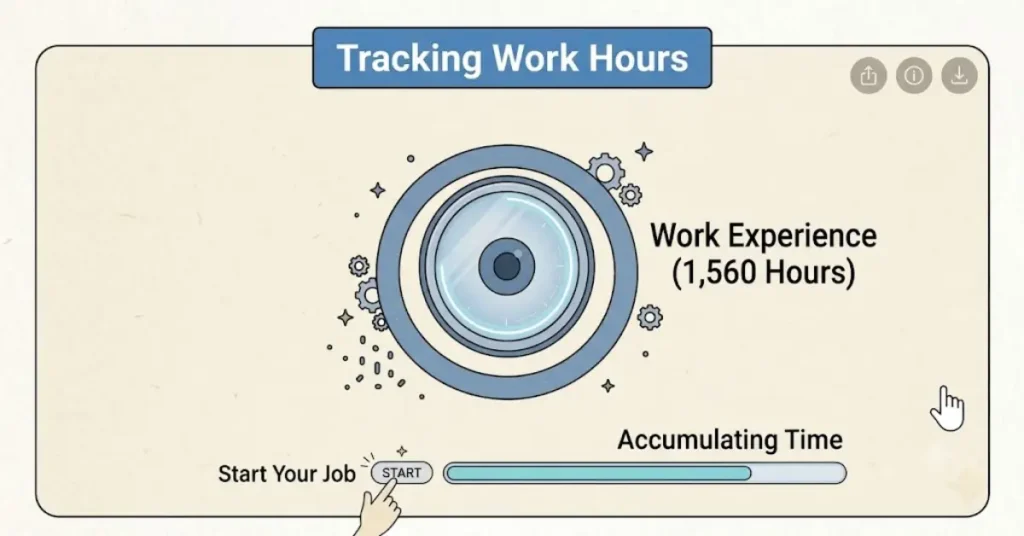
Work done on a PGWP counts toward CEC if it falls in a TEER 0, 1, 2, or 3 occupation and totals at least 1,560 hours, roughly 12 months of full-time work. Work done while you were a full-time student does not count, even if it was paid and in a skilled role. Part-time work across multiple qualifying jobs can be combined to reach the 1,560-hour threshold, but self-employment and unpaid internships are excluded entirely. That gives you a concrete target: secure TEER 0-3 employment on day one after graduation and track your hours from the start.
CRS Scores and What to Expect in 2026
According to IRCC draw records, CEC-specific Express Entry draws in 2026 have seen cutoff scores ranging from 507 to 523, with most draws landing between 507 and 521. The draw held on August 18 reached 523, the highest of the year to that point, while the lowest recorded score was 507, set in March. For Indian applicants, CRS scores often face pressure because foreign-earned education credentials receive fewer points than Canadian ones. That makes Canadian work experience, Canadian study credentials, and strong language scores disproportionately important for your CRS. Aim for CLB 9 or higher across all four abilities on your IELTS or CELPIP, and take the test early so your score is ready when your profile goes live.
Which Pathways Are Best for Indian Students to Get Canada PR Through Provincial Programs
Not every Indian student will clear a 510+ CRS score coming off a PGWP period. Provincial Nominee Programs fill that gap. Several provinces specifically designed graduate streams to attract international alumni who studied within their borders, and some of those streams do not require a job offer at all.
Ontario’s Master’s and PhD Streams: No Job Offer Required
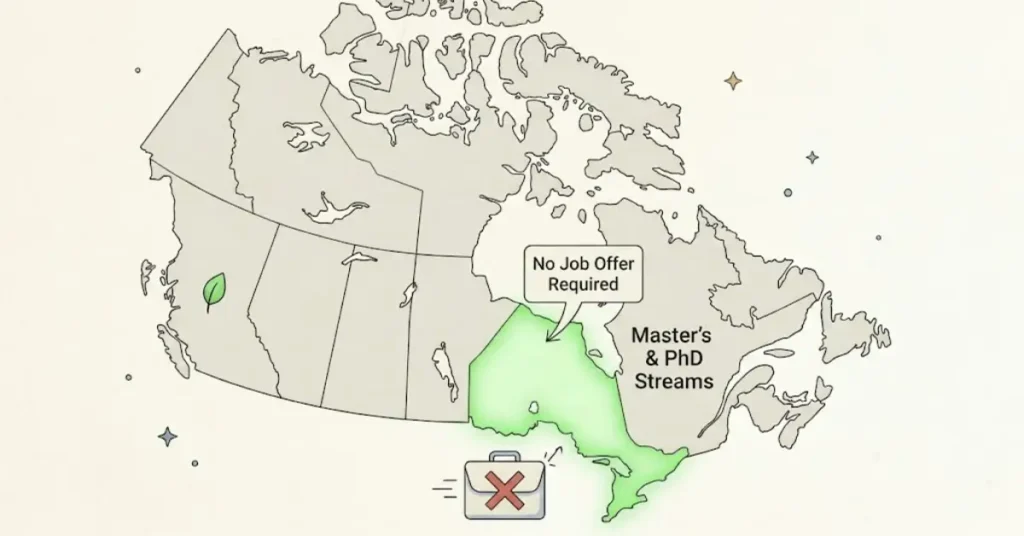
Ontario is a strong choice in 2026 for Indian students at the graduate level. The OINP Master’s Graduate Stream and PhD Graduate Stream are explicitly built for graduates of eligible Ontario universities and do not require a job offer. Based on OINP eligibility guidelines, requirements include graduating from an eligible Ontario institution within the relevant window and meeting language thresholds. Some streams also require applicants to demonstrate sufficient settlement funds, confirm the current requirements directly on the OINP website before applying, as these details can change. For master’s graduates who want a clear, employer-independent PR route, this stream paired with Ontario study is a well-regarded combination. Ontario also runs a separate Employer Job Offer: International Student stream for those who already have a qualifying offer from an Ontario employer.
Manitoba, PEI, Atlantic Provinces, and What Happened to BC
Manitoba’s Graduate Internship Pathway targets master’s and doctoral graduates who completed a Mitacs Elevate or Accelerate internship in the province. It requires CLB 7, graduation from a Manitoba institution within the last three years, and current residence in Manitoba. Prince Edward Island’s International Graduate Stream under its Labour Impact category gives priority to graduates of the province’s three post-secondary institutions. Newfoundland and Labrador’s International Graduate stream requires a PGWP and a full-time TEER 0-3 job offer of at least one year. New Brunswick has graduate-specific pathways targeting alumni of NB post-secondary institutions, with draws recorded in Q2 2026 confirming ongoing activity.
British Columbia eliminated its dedicated international graduate streams in 2026. Indian students who studied in BC must now route through other BC PNP pathways, most of which require a skilled job offer. If you are currently weighing BC against another province for graduate study, the absence of a no-job-offer graduate stream in BC is a real factor worth including in your decision.
For graduates looking west, PR pathways in Canada Alberta through the Alberta Advantage Immigration Program (AAIP) provide an alternative route. While Alberta maintains dedicated streams for local graduates, finding accessible PR pathways in Canada without a job offer has become exceptionally rare outside of Ontario’s master’s category, making upfront provincial selection critical before choosing an institution.
The Quebec Pathway Through the PEQ Program
Quebec operates its own immigration system. For Indian students who studied in Quebec and built genuine French proficiency, the Quebec Experience Program (PEQ) offers a direct path to provincial selection before federal PR. The program suits a specific profile, those with Quebec credentials and strong French skills, and the subsections below clarify exactly who qualifies.
The 2026 Reopening Window and Who Can Apply
Quebec announced the PEQ would reopen for a two-year window from July 2, 2026 to July 2, 2028, with an initial intake period running through October 31, 2026. The Graduates stream is open to international students who obtained a qualifying Quebec post-secondary credential by November 19, 2025, lived in Quebec for at least half of their study program, and are applying within three years of receiving that credential. If your credential was awarded before November 19, 2025 and you studied in Quebec, this window is directly relevant to your timeline.
French Language Requirements and Key Documents
The PEQ has firm language thresholds: NCLC 5 in reading and writing and NCLC 7 in speaking and listening. TEF Canada and TCF Canada are the accepted tests, though a transcript showing three or more years of full-time study in French can substitute in some cases. Key documents include your Quebec diploma, official transcripts, proof of Quebec residence during studies, and French test results. Quebec’s PEQ rules have changed multiple times in recent years, so verify every requirement directly on the official MIFI website before you prepare your application.
Which Degree Gives You the Strongest PR Edge?
The credential you pursue in Canada directly shapes your PGWP length, your PR timeline, and how many pathways remain open to you. In 2026, the divide between degree holders and short-cycle college graduates is stark: university degrees provide automatic exemption from IRCC’s restrictive field-of-study rules, while certificates and diplomas require strict alignment with in-demand CIP codes.
| Credential Type | PGWP Duration | Field-of-Study (CIP) Restriction | General PR Ease | Strategic Verdict |
| Master’s Degree | Up to 3 Years (even for programs under 2 yrs) | Exempt (All disciplines qualify) | Highest (Max CRS education points + extended work window) | Best overall choice: Maximum flexibility to hit the 1,560-hour CEC benchmark. |
| Bachelor’s Degree | Up to 3 Years (for 2+ year programs) | Exempt (All disciplines qualify) | High (Strong CRS base, but requires 3–4 years of tuition) | Safe, but long: Great security against policy shifts, with higher total study investment. |
| 2-Year College Diploma | Up to 3 Years | Restricted (Must match in-demand CIP codes) | Moderate (Lower CRS education score; relies heavily on category draws) | Viable with care: Cost-effective, provided your program code is strictly verified before enrolling. |
| 1-Year Certificate | Matches Program Length (e.g., 8–12 months) | Restricted (Must match in-demand CIP codes) | Challenging (Permit is often too short to guarantee 12 months of skilled work) | High risk: Leaves zero margin for hiring delays or gaps before your work permit expires. |
Why a Master’s Degree Is the Most Efficient PR Play
A master’s degree delivers three compounding PR advantages in 2026. First, most master’s graduates qualify for a three-year PGWP even if the program was under two years, provided the program met the 8-month minimum and IRCC eligibility conditions. Second, that three-year permit gives you the full window to accumulate 1,560 hours of CEC-qualifying skilled work experience. Third, it makes you eligible for Ontario’s Master’s Graduate Stream, which requires no job offer. That combination of a longer work permit plus a direct no-job-offer PNP option makes a master’s degree one of the most efficient credentials for Indian students targeting Canadian PR quickly.
Diploma and Certificate Programs: The Field-of-Study Risk
Diploma and certificate programs can still lead to a PGWP, but they carry more risk after November 2024. These credentials must fall within a PGWP-eligible field of study based on the CIP code of the program, be offered by an eligible DLI, and be at least 8 months long. Not all college programs qualify, and the specific CIP code matters more than the general subject area. The practical ranking for PR planning purposes is: master’s first, bachelor’s second, two-year diploma in a clearly eligible field third, and certificates only if every eligibility box is confirmed before enrollment.
Building Your Timeline and Taking the Right Next Steps
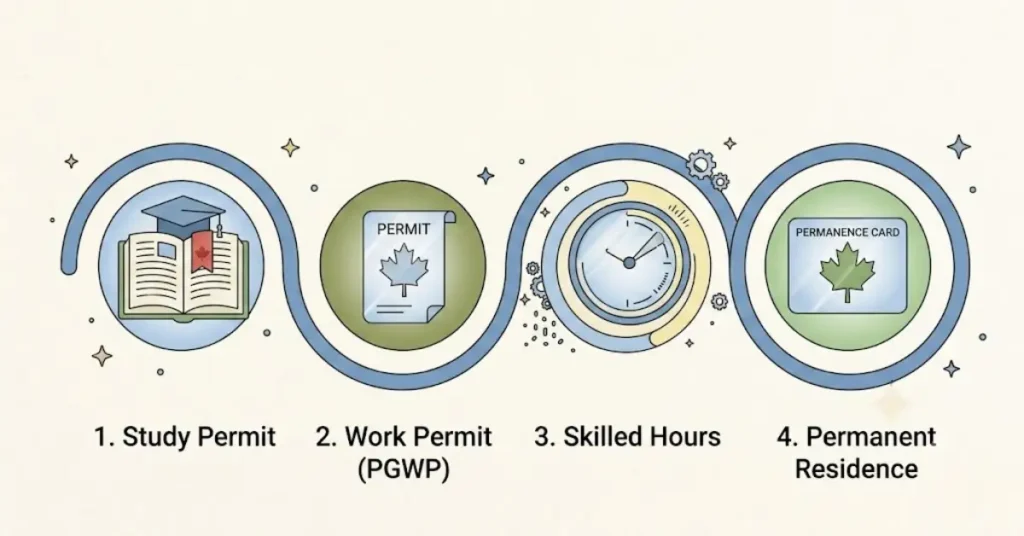
A realistic study-to-PR journey for an Indian student typically spans three to five years from the start of studies to receiving PR confirmation. The most common mistake is waiting until after graduation to think about the PR strategy. Every phase of the journey feeds into the next, and decisions made in year one of study directly affect your options in year three on a PGWP.
A concrete phase-by-phase roadmap looks like this:
- Years 1-2 (studies): Choose a PGWP-eligible program at an eligible DLI. Take IELTS or CELPIP early and target CLB 9 or higher. Research province-specific PNP graduate streams before you finalize where you study.
- Post-graduation, months 1-6: Apply for your PGWPwithin 180 days of program completion. Start a qualifying TEER 0-3 job as quickly as possible.
- Years 1-2 on PGWP: Accumulate 1,560 or more hours of skilled Canadian work experience. Create your Express Entry profile. Monitor PNP draw activity in your province.
- PR application: Submit your CEC or PNP-linked Express Entry application. IRCC processing times for CEC applications have been running around 6 to 7 months from submission to decision, as of 2026.
Beyond official IRCC manuals, operational case studies from peers provide the practical details that government portals omit. Following real-world applicant experiences on community platforms like The Post Villa reveals practical details about documentation bottlenecks, employer letter formatting, and processing timelines before you submit your file.
Choosing Your Path and Moving Forward
Ultimately, if you’re still asking what are the best pathways to get Canada PR for Indian students, the answer comes down to three core variables: the credential you earn, the province you study in, and how quickly you build skilled Canadian work experience after graduation. A master’s degree paired with Ontario or Manitoba gives you the most options with the fewest barriers. Express Entry’s CEC is the most predictable federal route once you have 12 months of TEER 0-3 work experience logged on your PGWP. Quebec is a strong option only if French proficiency is genuinely part of your plan, not something you intend to develop after arriving.
Whatever combination fits your profile, the time to map your PR strategy is before you finalize your study permit, not after you graduate. Align your program choice with your PR goal from the start, and the path to Canadian permanent residency becomes cleaner and far more predictable.