



Marketing teams often start quarterly planning with a simple operational question: “What should we publish next month?” Teams write calendars, produce social reels, record podcasts, and release blog posts to meet an internal schedule. This content-first workflow consistently wastes ad spend and production hours because publishing volume does not generate buying intent.
Effective marketing starts with customer actions, not content calendars. Content is merely the delivery vehicle; consumer behavior provides the strategic direction. When a business maps the exact problems prospects encounter, the technical questions they research, and the hesitations that stall transactions, content becomes targeted and profitable.
Defining Consumer Behavior in Marketing Management
In marketing management, consumer behavior represents the study of how individuals, businesses, and groups evaluate, purchase, use, and discard products or services. It tracks the psychological motivations, social dynamics, personal constraints, and situational variables that dictate why a prospect chooses one brand over an alternative.
Purchasing decisions do not happen in isolation. A B2B operations manager purchasing industrial machinery balances technical specifications, safety compliance, long-term maintenance costs, and internal approval chains. Conversely, a retail customer buying custom apparel evaluates fabric GSM, stitching durability, pricing transparency, and return convenience. Analyzing these underlying behavioral drivers allows marketing managers to align product positioning, pricing models, and educational resources directly with buyer priorities.
5 Core Influences on Buying Decisions
A customer’s decision to complete an order stems from distinct internal and external variables:
- Psychological Drivers: Measured by analyzing conversion rates against brand trust metrics and risk tolerance indicators (e.g., return rate data, customer service inquiry themes).
- Social Pressures: Verifiable through review sentiment analysis, social listening data, and referral traffic conversion patterns.
- Cultural Values: Operationalized by segmenting purchase behavior data by region and evaluating the performance of localized promotional messaging.
- Personal Demographics: Tracked directly within analytics platforms to identify high-performing segments by age, role, and purchasing power.
- Economic Conditions: Correlated with overall market trends and internal sales cycle data to adjust strategy based on market volatility.
4 Types of Consumer Buying Behavior
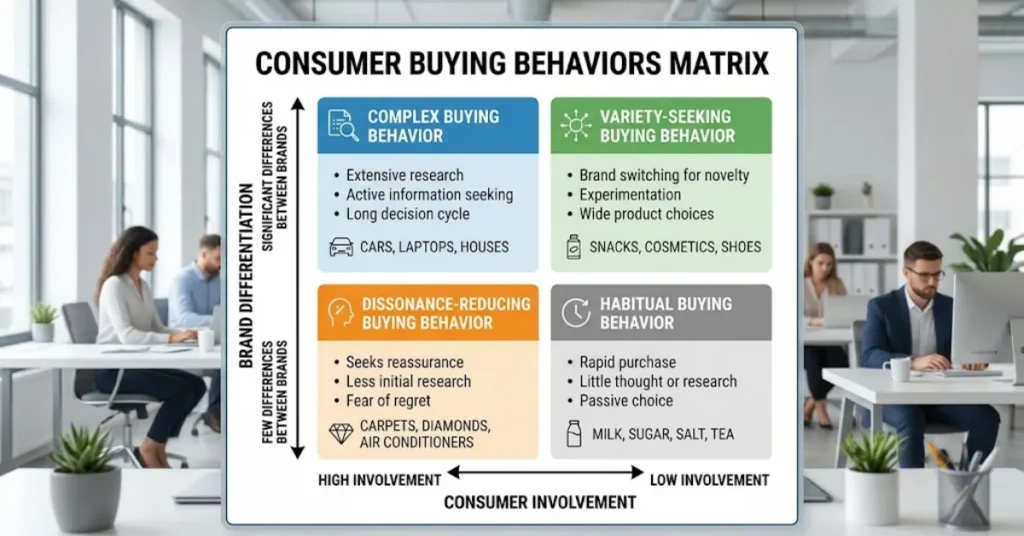
Buyers allocate research time and financial resources based on perceived transaction risk and available brand differences:
| Buying Behavior Type | Perceived Risk Level | Brand Differentiation | Typical Buyer Action | Analytics & Content Optimization |
| Complex Buying Behavior | High | Significant | Researches technical specifications, reads third-party audits, and compares vendors. | Track time-on-page and assist conversions for deep-dive technical assets. |
| Dissonance-Reducing Behavior | High | Low | Seeks immediate operational reassurance to prevent post-purchase regret. | Monitor conversion rates for warranty pages and measure verified review impact. |
| Habitual Buying Behavior | Low | Low | Purchases out of routine or familiarity, not active evaluation. | Focus on transactional data, repeat purchase frequency, and frictionless checkout flow. |
| Variety-Seeking Behavior | Low | Significant | Switches brands for novelty or variety, not dissatisfaction. | Analyze churn rate data and bundle performance metrics. |
How to Validate Customer Behavior with Marketing Analytics
A strategy built on assumed consumer behavior is mere speculation. The only way to move beyond conjecture and generate predictable ROI is by grounding every marketing decision in verifiable data. Marketing analytics and data-driven insights are the essential mechanisms that transform consumer psychology into an executable commercial framework.
Instead of guessing what your customers prioritize, look at transactional data to find true purchase patterns. Analyze web analytics and behavioral reports to identify where prospects lose interest on your landing pages. This hard data validates the theoretical framework of the buyer decision process. Without this continuous loop of data-driven verification, you are optimizing for a hypothetical audience, which is a guaranteed way to waste budget.
Mapping Customer Decision Stages to Content Assets
A profitable marketing framework aligns digital assets directly with the five sequential steps of the buyer journey:
1. Problem Recognition (Awareness Stage)
The buyer notices an operational bottleneck, material defect, or personal requirement. Sales pitches published at this stage create high bounce rates because the prospect has not yet defined their solution criteria. Marketing assets must diagnose symptoms through technical diagnostic checklists, benchmark reports, and industry problem breakdowns.
2. Information Search (Research Stage)
The prospect actively searches online databases, vendor catalogs, search engines, and peer groups to discover viable methodologies. The content must outline procedural steps, provide how-to walkthroughs, and explain technical standards without aggressive sales pressure.
3. Evaluation of Alternatives (Consideration Stage)
The prospect reviews competing vendors, comparing performance metrics, material durability, lead times, and total cost of ownership. Content must provide direct side-by-side comparison tables, verified customer case studies, and transparent pricing breakdowns.
4. Purchase Action (Conversion Stage)
The prospect chooses a vendor and prepares to execute the transaction. Marketing assets must eliminate commercial friction by displaying clear payment terms, verified return policies, live inventory availability, and simple checkout pathways.
5. Retention and Advocacy (Post-Purchase Stage)
The customer evaluates real-world product performance against pre-purchase expectations. To prevent buyer regret and secure recurring orders, content must deliver onboarding tutorials, maintenance schedules, warranty registration workflows, and direct technical support channels.
Why Every Industry Demands a Different Content Approach
Customer habits change completely from one market to another, so using the same content plan for every business does not work. Agencies like 11 Media Branding & Marketing Agency have seen this in their work across fields like jewellery, ceramics, manufacturing, construction, fashion, hospitality, and cosmetics.
In fields like manufacturing or construction, buyers focus on product details, technical sheets, and clear cost breakdowns before they make a deal. In retail fields like fashion, jewellery, or cosmetics, buyers care more about clear product photos, fabric and material quality, and an easy checkout process.
Marketing works best when it matches how people actually shop in each industry. When a business ignores these differences and posts generic content, buyers simply move on to competitors who answer their exact questions.
Using Search Intent to Track Real-Time Customer Intent
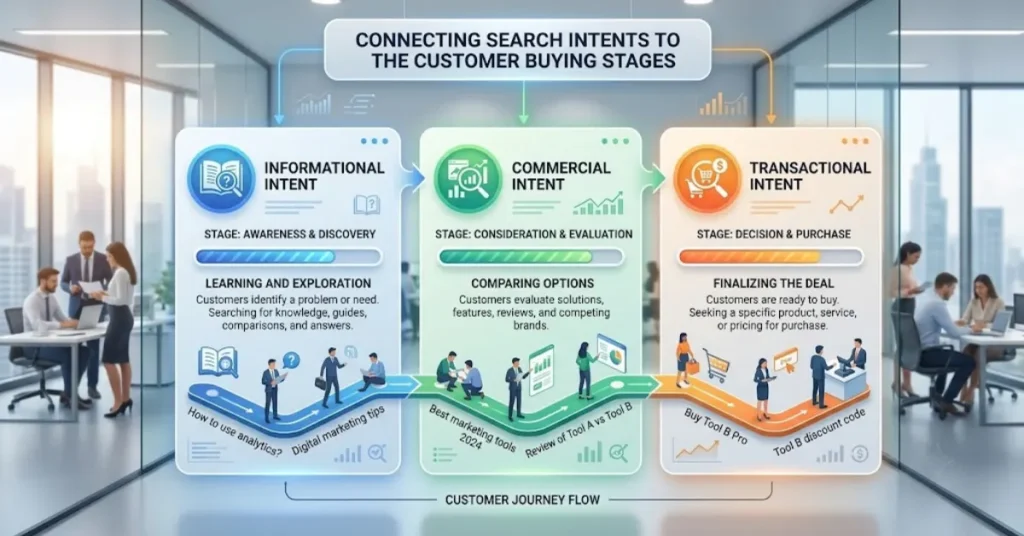
Search queries represent unfiltered customer intent. Instead of chasing broad search volumes, organize keyword research by decision stages:
- Informational Queries: Searches like “what is consumer behavior in marketing management“ indicate early research where readers require definitions, underlying principles, and structured breakdowns.
- Commercial Investigation Queries: Searches like “best custom clothing manufacturers India” show that the buyer has identified their requirement and is actively building a vendor shortlist based on specifications and pricing.
- Transactional Queries: Searches like “order 240 GSM oversized graphic tees” indicate immediate purchasing intent. These landing pages require fast load speeds, transparent pricing tables, clear minimum order quantities, and simple checkout interfaces.
- Navigational Queries: Searches like “Google Merchant Center login” or specific brand names indicate an existing user looking for direct account access or documentation.
Answer Engine Optimization (AEO) and Generative Search Execution
Search discovery has expanded from short keyword matching to complex conversational prompts submitted to AI answer engines like Google AI Overviews, Gemini, Perplexity, and ChatGPT. Capturing visibility across these systems requires specific formatting standards:
- Direct Answer Placement: Place direct, 30-to-50-word factual answers immediately below question-based H2 headers to allow search crawlers to index definitions without parsing conversational fluff.
- Machine-Readable Scaffolding: Organize multi-variable data, such as pricing, material specs, and buying behaviors, into clean HTML and Markdown tables.
- Structured Schema Markup: Apply valid
Article,FAQPage, andProductJSON-LD schema markup to web pages so generative crawlers extract entities accurately. - Factual Precision: Support marketing claims with exact operational numbers, testing standards, and verified performance data rather than generalized statements.
5 Steps to Build a Customer-Centric Marketing Framework
Transitioning from an unguided publishing schedule to an intent-based marketing strategy requires a structured internal workflow:
- Step 1: Audit Direct Customer Touchpoints: Review sales call logs, customer service tickets, live chat transcripts, and site search queries to catalog recurring objections, common points of confusion, and buying triggers.
- Step 2: Map the Primary Decision Path: Document the exact stages a prospect completes before buying, noting the specific information required to advance from one stage to the next.
- Step 3: Conduct Intent-Based Keyword Research: Group targeted search terms into informational, commercial, and transactional buckets rather than organizing solely by raw search volume.
- Step 4: Produce Targeted Asset Types: Build dedicated landing pages, technical comparison tables, and FAQ sections designed to resolve specific buyer hesitations.
- Step 5: Measure Conversion Performance: Track business metrics, including conversion rates, assisted conversions, cost per acquisition, and customer retention, rather than superficial traffic numbers.
Why Consumer Behavior is Important in Marketing Strategy
Consumer behavior is important in marketing strategy because publishing schedules alone do not generate sales. Content that fails to address customer objections or buying stages leads to high bounce rates and wasted ad spend. When every landing page, comparison matrix, and technical walkthrough aligns with verified customer actions, marketing shifts from an unguided operational cost into a high-converting revenue driver.