



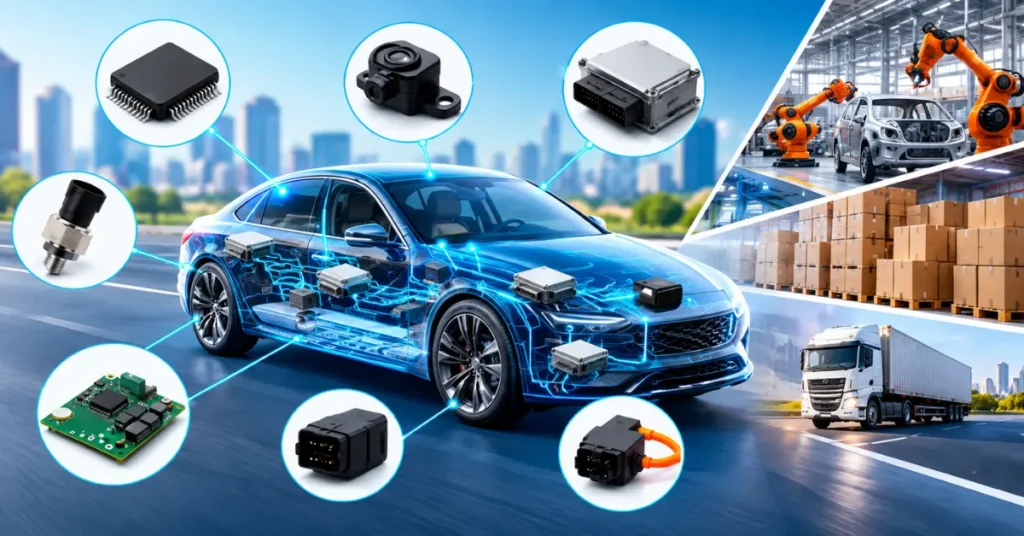
Modern vehicles depend heavily on electronic control units to execute critical operations. Historically, mechanical assemblies governed these tasks alone. Today, computational demands range from core engine actuation and anti lock braking to battery cell supervision. In addition, computing systems manage infotainment screens, thermal cooling loops, and telematics. Consequently, the automotive ECU supply chain has become the foundational backbone of contemporary vehicle design and manufacturing. Furthermore, software heavy electric models require even greater computing density than older platforms.
This architectural shift fundamentally alters procurement structures across the global vehicle manufacturing sector. As a result, automotive original equipment manufacturers no longer focus primarily on sheet metal stamping and cast iron engine blocks. Modern production schedules demand continuous access to automotive grade semiconductors. Therefore, automakers must secure embedded firmware developers, safety critical sensors, and cybersecurity protocols alongside physical hardware.
Evolution of Powertrain Computing from Mechanical Linkages
Vehicle powertrain operations have transitioned from analog hydraulic regulators to real time computational control loops. Internal combustion platforms mandate high speed microcontrollers to govern multi stage fuel injection and variable valve timing. In addition, these chips regulate exhaust aftertreatment chemistry, automated gear shifting, and on board diagnostics. Electric vehicle architectures amplify processing complexity even further. Specifically, electric drivetrains deploy controllers for high voltage battery pack monitoring, power conversion, and regenerative braking deceleration.
Each electronic control module contains an integrated microcontroller unit, volatile storage, and power management circuits. Furthermore, physical layer transceivers execute low level firmware across the unit. Advanced vehicle platforms coordinate thousands of discrete surface mount components across distributed circuit boards to preserve functional safety.
However, this granular architecture creates serious procurement risks within the automotive ECU supply chain. A microchip costing less than three dollars can halt assembly lines if it governs steering actuation or battery contactors. For example, the global automotive chip supply shortages demonstrated how microchip bottlenecks disrupt multi billion dollar vehicle manufacturing programs worldwide.
Transition to Domain and Zonal Vehicle Electrical Architectures
Automakers are actively phasing out fragmented clusters of low cost controllers. Instead, engineering teams favor consolidated domain and zonal computing platforms. Traditional platform engineering distributed individual electronic control units across separate functional tasks throughout the cabin. In contrast, contemporary electrical architectures group related sub systems into centralized domain units or location specific zonal gateways.
Domain processing platforms unify steering, braking, suspension, and body controls into singular high performance compute nodes. Meanwhile, zonal architectures simplify physical packaging by aggregating sensor signals and actuator controls based on spatial quadrants within the vehicle frame.
This architectural migration shifts the automotive ECU supply chain significantly. As a result, automakers order fewer entry level microcontrollers while scaling purchases of multi core system on chip processors. A single central compute engine replaces multiple legacy modules. Therefore, these larger units require dedicated thermal heat sinks, robust transient voltage suppression, and high bandwidth network connections.
Physical networking infrastructure is updating concurrently to support elevated data throughput. For instance, Automotive Ethernet protocols delivering one hundred megabits per second and gigabit speeds replace legacy local interconnect networks. Consequently, high speed buses can transmit dense data streams from optical cameras, radar sensors, and digital cockpit graphics.
Structural Reorganization of Modern Tier Supplier Networks
The rise of vehicle compute platforms has dissolved the conventional hierarchical relationship between automakers and component makers. Traditional automotive procurement relied on Tier 1 integrators delivering fully assembled mechanical hardware. Lower tier fabricators simply supplied raw commodities and stampings to those integrators.
Modern electrical systems introduce software houses, semiconductor foundries, and systems engineering specialists directly into early platform planning. For example, an automated driving compute platform requires collaborative integration between silicon fabricators and board layout contractors. In addition, projects require input from operating system vendors, cryptography auditors, and environmental testing laboratories.
Contemporary sourcing networks within the automotive ECU supply chain operate across multiple technical layers.
- Tier 1 integrators manufacture integrated electronic control units, domain processing racks, and smart mechatronic modules.
- Tier 2 manufacturers deliver application specific microcontrollers, image sensors, flash memory, gate drivers, and physical transceivers.
- Tier 3 suppliers provide raw silicon wafers, ceramic capacitors, lead frames, engineered resins, and printed circuit board substrates.
- Software vendors develop certified real time operating systems, hardware abstraction layers, middleware stacks, and over the air deployment pipelines.
- Engineering providers deliver formal verification for ISO 26262 functional safety, cryptographic penetration testing, and electromagnetic compatibility compliance.
Therefore, a production vehicle platform integrating ten primary electronic domains requires coordinated project execution across hundreds of hardware, software, and testing partners.
Strategic Procurement Protocols for Automotive Semiconductors
Microchip sourcing has transitioned from an indirect purchasing task into a central corporate risk mitigation discipline. Microcontrollers designed for vehicular operation must endure severe thermal cycles and mechanical vibration. In addition, these chips must tolerate wide voltage transients across an operational lifespan exceeding fifteen years.
Automotive grade silicon must pass AEC Q100 qualification standards. Specifically, these components must function reliably across temperatures ranging from negative forty degrees Celsius to one hundred and twenty five degrees Celsius. Furthermore, safety critical microcontrollers governing steering assist, stability control, and high voltage isolation require rigorous fault tree analysis before receiving production approval.
Vehicle development timelines conflict directly with commercial semiconductor product lifecycles. Designing and homologating a new automotive platform spans five to seven years. In contrast, consumer semiconductor technology cycles advance every eighteen to twenty four months.
Consequently, automotive purchasing executives now establish direct strategic agreements with semiconductor fabrication facilities. Automakers build critical buffer inventories and negotiate long term wafer capacity allocations. Securing alternate pin compatible microcontrollers requires extensive engineering investments. Indeed, alternative silicon options exhibit distinct electrical parameters, register sets, and peripheral driver requirements.
The structural contrast between older automotive sourcing models and modern electronics procurement highlights the shifting technical requirements facing procurement teams.
| Sourcing Dimension | Traditional Automotive Model | Modern Automotive ECU Supply Chain |
| Compute Layout | Discrete function specific modules | Centralized domain and zonal processing nodes |
| Code Footprint | Basic fixed embedded microcode | Millions of code lines with modular middleware |
| In Vehicle Networks | Controller Area Network and LIN dominant | High speed Automotive Ethernet and CAN FD |
| Silicon Intensity | Low silicon content per chassis | Thousands of discrete active semiconductor dies |
| Vendor Base | Direct mechanical Tier 1 integrators | Mixed network of chip foundries and software vendors |
| Post Sale Servicing | Physical replacement in service bays | Over the air remote firmware updates |
| Quality Assurance | Mechanical tolerance and endurance testing | Combined hardware in the loop and software validation |
Long Term Lifecycle Management for Automotive Software Assets
The expansion of embedded microcontrollers establishes software code as a major bill of materials asset within the automotive ECU supply chain. Contemporary luxury and electric vehicles execute upwards of one hundred million lines of code across distributed processors. In addition, software coordinates graphic rendering engines and wireless communication modems.
Software maintenance commitments continue long after vehicles roll off final assembly lines. Over the air connectivity allows vehicle manufacturers to deploy bug patches and update battery management algorithms. Furthermore, engineers can calibrate powertrain response and activate optional features without requiring authorized dealership appointments.
This wireless capability extends supplier obligations across the entire operating lifespan of the vehicle fleet. As a result, silicon suppliers and software contractors must support legacy chip variants with functional security patches. Teams must maintain updated cryptographic certificates and driver packages for over a decade.
Therefore, automotive supply chains now encompass continuous integration testing platforms and cloud infrastructure alongside traditional physical fabrication plants.
Electrification Demands Across High Voltage Powertrain Components
Electric vehicle powertrains require specialized electronic control units engineered to manage high voltage battery chemistry and dynamic energy transfer. Battery management controllers monitor cell voltage, state of charge, operating temperature, and internal impedance. Consequently, these controllers ensure operational safety and prevent thermal runaway events.
Traction drive electronics depend on dedicated microcontrollers to govern pulse width modulation across high power silicon carbide or silicon MOSFET switches. In addition, high voltage auxiliary units convert battery pack current through isolated DC to DC converters. Onboard chargers regulate incoming alternating current, while smart actuators optimize motor regeneration during vehicle braking events.
High voltage management systems expand the commercial footprint of automotive electronics significantly. According to market research from Dataintelo, the global automotive electronic control unit market reached $54.8 billion in 2025. Projections indicate this valuation will reach $102.6 billion by 2034, registering a compound annual growth rate of 7.2 percent. Consequently, electrification accelerates procurement volume across specialized computing categories and reshapes the automotive ECU supply chain.
Therefore, power electronics manufacturers, current sensor developers, and wide bandgap semiconductor producers represent primary strategic suppliers for passenger and commercial vehicle programs.
Strategic Realignment of OEM and Technology Partnerships
The software defined vehicle model requires automakers to view vehicular electronics as an extensible computing platform rather than a collection of isolated controllers. Centralized computing simplifies cable routing harnesses and reduces overall component weight. At the same time, this strategy concentrates critical vehicle systems into powerful multi core processors.
This integration alters supplier evaluation criteria during platform development programs. For example, Tier 1 partners must demonstrate software portability and robust functional safety architectures. In addition, suppliers must deliver secure boot validation and standardized communication interfaces alongside mechanical packaging precision.
However, centralized processing introduces concentrated operational dependencies. A failure inside an unpartitioned central domain platform can simultaneously compromise instrument cluster displays, climate functions, and telematics connectivity. Original equipment manufacturers and Tier 1 suppliers address this operational risk by implementing hardware level memory protection. Furthermore, engineers employ spatial software partitioning and redundant backup processors.
Ultimately, managing a resilient automotive ECU supply chain requires automakers to bypass traditional intermediary brokers and engage directly with semiconductor foundries and software developers. These long term collaborative ecosystems secure stable chip production allocations. In addition, direct partnerships streamline over the air software delivery pipelines and build resilient electronic architectures capable of supporting autonomous operations.